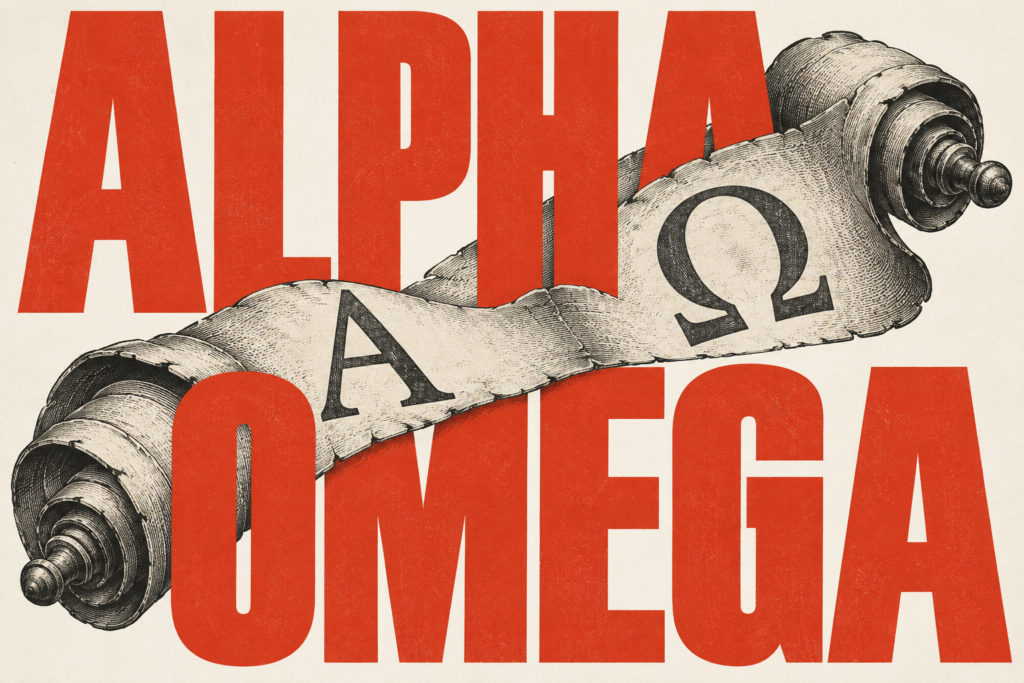
There is a line in Revelation that nearly every Christian recognizes:
“I am the Alpha and the Omega, the First and the Last, the Beginning and the End.”
— Revelation 22:13
I had always understood why this verse was important.
Christ is making a claim to divinity.
“The First and the Last” is not merely a poetic description of Jesus. It deliberately recalls the language God uses of Himself in the Old Testament:
“I am the first and I am the last; besides me there is no god.”
— Isaiah 44:6
Again:
“I am he; I am the first, and I am the last.”
— Isaiah 48:12
Then, in Revelation, Christ takes this language upon Himself.
“I am the First and the Last.”
That alone is extraordinary. Christ is not presenting Himself merely as another prophet pointing toward God. Nor is He merely claiming to be a human Messiah commissioned by God. He takes upon Himself the identity-language of the God of Israel.
But there is something else in Revelation 22:13 that I had never really stopped to think about.
Alpha and Omega are Greek.
That sounds almost embarrassingly obvious.
And yet the more I thought about it, the less trivial it became.
Why Alpha and Omega?
Alpha is the first letter of the Greek alphabet.
Omega is the last.
So when Christ says:
“I am the Alpha and the Omega…”
He is saying, through the alphabet itself:
“I am the Beginning and the End.”
That is why the verse initially appears repetitive:
“I am the Alpha and the Omega,
the First and the Last,
the Beginning and the End.”
He says essentially the same thing three times.
But the first formulation is different from the others.
It is language-specific.
“First and Last” can be translated into Hebrew.
“Beginning and End” can be translated into Hebrew.
But Alpha and Omega cannot remain Alpha and Omega in Hebrew.
The corresponding Hebrew letters would be Aleph and Tav.
Alpha and Omega only function as the beginning-and-end symbolism they are because the revelation has been given to us in Greek.
And suddenly the repetition becomes interesting.
The ancient divine title—First and Last, Beginning and End—is now being expressed through the alphabet of the language in which the New Testament itself would be written.
From the Hebrew Scriptures to the Greek New Testament
This becomes especially striking when placed within the larger history of Scripture.
The Old Covenant comes to us principally through the Hebrew Scriptures. The New Testament comes to us in Greek.
And the earliest Church existed in a world where Greek was enormously important. The Septuagint—the Greek translation of the Old Testament—became the scriptural Bible of the Greek-speaking Christian world and is deeply embedded throughout the New Testament.
Then Revelation gives us the glorified Christ identifying Himself through the Greek alphabet:
Alpha. Omega.
The God who declared in Isaiah:
“I am the first and I am the last”
is now revealed in Christ, and that same divine identity is proclaimed through Greek:
“I am the Alpha and the Omega.”
That does not abolish what came before it.
It fulfills it.
The Hebrew revelation has not been discarded. Its meaning has been carried forward into the language of the New Covenant Church.
The same God.
The same divine identity.
The same revelation.
But now proclaimed to the nations.
Did Jesus Actually Say It in Greek?
There is an important distinction here.
In the Gospels, the evangelists frequently record in Greek things Jesus may originally have spoken in Aramaic. Occasionally they preserve the original expression—Talitha koum, for example—and then explain its meaning.
Revelation presents a different situation.
John is not recalling an ordinary conversation from Christ’s earthly ministry decades earlier. He is receiving a revelation from the risen and glorified Christ and being commanded to write what he sees and hears.
And the revelation we possess is Greek.
We cannot historically prove from the manuscript alone that the audible language John heard in the vision was Greek rather than Christ communicating an equivalent concept that John rendered into Greek.
But that distinction does not eliminate the observation.
From the Christian understanding of inspiration, the Greek formulation itself belongs to the revelation Scripture gives the Church.
Whether Christ spoke the Greek sounds directly to John or inspired John to express the revelation as Alpha and Omega, Christ is not somehow trapped behind the Greek text waiting for us to reconstruct a supposedly more authentic Hebrew Christianity.
The Greek is not an unfortunate corruption standing between us and the real message.
It is the canonical form in which the Church received the revelation.
And the symbolism actually works because it is Greek.
This Creates a Serious Problem for “Hebrew-Only” Christianity
This is where the observation becomes apologetically interesting.
Imagine the exchange:
“Jesus’ real message has to be recovered through Hebrew.”
Then why does Revelation present Jesus saying:
“I am the Alpha and the Omega”?
“Because He means He is the beginning and the end.”
Exactly.
And what are Alpha and Omega?
They are the beginning and end of the Greek alphabet.
You cannot dismiss the Greek character of Christianity as some later corruption without eventually having to contend with Christ’s own revelation as preserved by an apostle.
And this produces what I think is a threefold problem for attempts to reconstruct Christianity as essentially Hebrew in opposition to the historic Greek-speaking Church.
First, the language.
Christ’s title is expressed through an explicitly Greek symbol: Alpha and Omega.
Second, the divinity.
The Greek expression is immediately joined to “First and Last” and “Beginning and End,” connecting Christ with the divine identity proclaimed in Isaiah.
Jesus cannot easily be reduced to merely a human Jewish Messiah here. The Messiah is taking upon Himself the identity-language of the God of Israel.
And third, John.
This is not Paul.
That matters because so many attempts to construct an alternative “original Christianity” eventually turn Paul into the culprit. Jesus was supposedly teaching one thing, and then Paul entered the picture, Hellenized Christianity, deemphasized its Jewish character, and transformed it into something Jesus never intended.
But Revelation creates a serious problem for that narrative.
You can remove Paul from the equation entirely.
You still have John.
You still have Revelation.
You still have Christ claiming divine identity.
And you still have:
Alpha and Omega.
The Greek character cannot simply be blamed on Paul.
The Vindication of What Came Next
This is where the realization became much larger for me as I have been coming into Orthodoxy.
Because I began asking another question:
What actually happened after Christ?
The Gospel went into the Greek-speaking world.
The apostles established churches throughout that world.
The New Testament was written in Greek.
The Greek Old Testament was extensively used by Christians.
The apostolic Church developed and transmitted its faith through bishops who succeeded the apostles.
And Christians understood this process not as an accident of secular history, but as something occurring under the guidance of the Holy Spirit.
That makes Alpha and Omega fascinating in retrospect.
Before the centuries of Greek Christian theology, before the great councils, before the enormous Greek theological vocabulary through which Christians would defend the Trinity and the Incarnation, Revelation already presents the glorified Christ through an explicitly Greek formulation.
Alpha and Omega.
The later Greek-speaking Church therefore cannot simply be dismissed as something foreign that attached itself to an originally Hebrew Christianity.
Greek is already there.
It is there in the New Testament.
It is there in the scriptural world inherited by the early Church.
And, remarkably, it is there in Christ’s own divine title in Revelation.
The Church did not somehow stumble into Greek while Christ remained behind in Hebrew.
The canonical revelation itself meets the Greek-speaking Church in Greek.
The Church Was Not an Accident
And this is where, for me, the observation becomes much more than an argument about language.
It becomes an argument about providence.
If Christ knew what His Church would become—and Christianity necessarily says that He did—then the history that follows His Resurrection cannot be treated as though it surprised Him.
Christ knew the apostles.
He knew their mission.
He knew the nations to whom the Gospel would go.
He knew the Scriptures the Church would receive.
He knew the language in which the New Testament would be preserved.
And Revelation presents Him speaking to churches in that world while calling Himself by the first and last letters of their alphabet.
That does not, by itself, prove every subsequent Orthodox claim about ecclesiology. Apostolic succession and the identification of the historic apostolic Church still have their own historical and theological arguments.
But it removes one very important escape route.
You cannot simply say:
“The Greek Christians took Jesus somewhere He never intended Christianity to go.”
The New Testament itself will not permit such an easy separation.
The glorified Christ is already there.
Alpha and Omega.
The First and the Last.
The Beginning and the End.
And that is becoming increasingly significant to me as I enter Orthodoxy.
I am not discovering a Christianity that asks me to abandon the world of Christ and the apostles for some later Greek construction.
I am discovering the connectedness of the whole thing.
The God who says in the Old Testament, “I am the First and the Last,” is the Christ who says in Revelation, “I am the Alpha and the Omega.”
The revelation given to Israel becomes the Gospel proclaimed to the nations.
The apostles carry it outward.
The Holy Spirit guides the Church.
And the Church continues.
What initially looked like three synonymous phrases in a single verse suddenly looks like a miniature picture of the entire movement:
Alpha and Omega.
First and Last.
Beginning and End.
Not replacement, but fulfillment.
Not contradiction, but continuity.
Not a different God, a different revelation, or a different faith.
The same God who was there at the beginning, revealing Himself as the First and the Last, is there at the fulfillment—speaking to His Church in the language through which His New Covenant would go out into the world.
He is, after all, the Beginning and the End.


