Arguments against the existence of God face a fundamental difficulty: they must first assume the existence of the very things whose ultimate explanation is in dispute.
An atheist may reject God, deny divine revelation, dismiss theology, and insist that the universe is entirely natural. But in making any of these claims, he must appeal to logic, reason, intelligibility, and truth. He must assume that his words have meaning, that his conclusions follow from his premises, and that reality is sufficiently coherent for either of us to understand what he is saying.
He must also assume that his argument is not merely true for himself.
If he claims that God does not exist, he presumably means that God does not exist regardless of whether I believe otherwise. His claim is intended to describe reality, not merely his personal experience of it.
And so, before we ever begin debating whether God exists, we encounter a more fundamental question:
What makes anything true at all?
This is the question at the heart of the Transcendental Argument for God.
Truth Is What Is the Case
We often speak about truth as though it were something people possess, construct, or decide.
Someone believes something is true. Someone else believes it is false. We then ask which person is correct.
But notice what we are actually asking.
We are not asking which person believes more strongly. We are asking which belief corresponds to what is actually the case.
If someone believes something is true, and it is the case, then what they believe is true. But their belief is not what makes it true.
What makes it true is that it is the case.
This distinction is elementary, yet it is extraordinarily important.
Human beings invented the word death. We developed language to identify and describe the phenomenon. But we did not invent death itself.
Death existed before anyone named it, understood it, or developed a scientific explanation for it.
A person does not escape death by refusing to believe in it. Their belief has no authority to alter the biological reality being described.
We should be precise here: the fact that human beings have died throughout history gives us powerful evidence about human mortality. It does not, by itself, logically prove that every future human must die. Nevertheless, the distinction remains.
Our concepts describe reality. They do not ordinarily manufacture the reality they describe.
This is the correspondence understanding of truth: a proposition is true insofar as it corresponds to what is the case.
And it immediately raises a question that reaches far beyond human opinion.
If truth is independent of what we believe, what ultimately accounts for the reality to which our beliefs must correspond?
The Question That Comes Before the Argument
Imagine someone approaches me and says:
“Your worldview is false. Let me convert you to presuppositional atheism.”
Before defending Christianity, I would like to understand what this person is claiming.
What is presuppositional atheism?
What must someone believe to accept it?
Why should I believe it?
And most importantly:
Is your position true whether or not anyone believes it?
If the answer is yes, then we have established something important.
We agree that truth is not simply a matter of personal preference.
Suppose no human beings existed. Would the universe cease to exist with us? Would reality itself disappear because there was nobody present to observe it?
A realist will ordinarily answer no.
Reality does not depend upon human beings acknowledging it.
Likewise, if the proposition “God does not exist” is true, the atheist presumably believes it would remain true even if no human being ever entertained the proposition.
This establishes our common ground.
We are both making claims about an objective reality.
But the conversation cannot end there.
The next question is:
What makes your claim true?
It is important not to confuse this question with “How do you know?”
The latter concerns epistemology: how we acquire and justify knowledge.
The former concerns ontology and metaphysics: what actually exists, and what makes a proposition true.
An atheist may offer evidence for the nonexistence of God. He may propose a theory of truth, a philosophy of logic, or a naturalistic explanation of the universe.
These are legitimate possibilities to examine.
But merely declaring that something is objectively true does not demonstrate that it is.
And merely appealing to logic does not yet explain why logic is applicable to reality.
This is where the deeper argument begins.
The Transcendental Argument for God
The Transcendental Argument for God, commonly abbreviated TAG, does not begin by examining an individual object in the universe and asking what caused it.
Instead, it asks what must already be true for rational examination to be possible in the first place.
What makes logic possible?
What makes knowledge possible?
Why is the universe intelligible?
Why can the human mind understand an external reality?
Why should the principles of reasoning apply beyond our own individual thoughts?
Why is scientific investigation possible at all?
These are questions about the preconditions of intelligibility.
In the Orthodox presuppositional approach associated with thinkers such as Jay Dyer, the argument is that these preconditions cannot ultimately be grounded in an impersonal, contingent, purely material account of reality.
Instead, they require the eternal, rational, personal God revealed in Christianity.
The argument can be expressed simply:
- Rational thought and knowledge presuppose logic, intelligibility, and an ordered reality.
- These preconditions require an adequate ultimate metaphysical ground.
- The Triune God is the necessary ground of those preconditions.
- Therefore, the possibility of rational thought and knowledge presupposes God.
The crucial premise is the third.
It is not enough to observe that logic exists and then simply announce that God must exist. The argument must demonstrate why competing accounts fail and why the Christian understanding of God provides the necessary foundation.
That is precisely what makes TAG a transcendental argument rather than an ordinary argument from ignorance.
It is not merely saying, “We do not know why logic exists, therefore God.”
It is arguing that the possibility of logic, knowledge, and intelligibility depends upon the kind of reality Christianity describes.
And within Eastern Orthodoxy, this argument takes on a particularly significant theological character.
In the Beginning Was the Logos
The opening of John’s Gospel is among the most philosophically profound passages in all of Scripture.
“In the beginning was the Word, and the Word was with God, and the Word was God.”
— John 1:1
The Greek word translated as Word is Logos.
But Logos carries a richness of meaning that the English word alone cannot fully convey.
It encompasses word, speech, reason, and rational principle.
This is not an accidental association.
Christianity does not merely claim that God possesses reason, as though reason were some external standard to which God must conform.
It identifies the divine Logos with the eternal Son, Jesus Christ.
The Logos is not a creature within the universe attempting to understand its laws.
He is the One through whom the universe itself was made.
“All things were made through Him, and without Him nothing was made that was made.”
— John 1:3
This is the extraordinary claim of Christianity.
Reality is intelligible because its source is not unintelligible.
Creation is ordered because it proceeds from divine wisdom.
The human mind is capable of understanding creation because humanity is made in the image of God.
Reason is not an inexplicable accident floating within an otherwise irrational existence.
It is possible because reality itself is grounded in the Logos.
In Orthodox theology, this relationship is further illuminated by the teaching of the logoi of created things, particularly in St. Maximus the Confessor.
The logoi are the divine principles, meanings, and purposes according to which created things exist. They are grounded in the one divine Logos.
Creation is therefore neither independent of God nor identical to God.
It is intelligible because it has been brought into being through divine wisdom.
The world does not become rational when human beings begin describing it. Human beings can describe it because it is already intelligible.
The Orthodox Distinction Between Essence and Energies
Eastern Orthodoxy provides another important theological distinction.
God is transcendent, but He is not inaccessible in every respect.
Orthodox theology distinguishes between God’s essence and His uncreated energies.
God’s essence remains beyond creaturely comprehension. We cannot contain, exhaust, or fully define what God is in Himself.
Yet God genuinely reveals Himself and acts within creation through His energies.
These energies are not created substitutes for God. They are God’s own uncreated activity and presence.
This distinction matters because TAG concerns how finite creatures can participate in and understand a reality whose ultimate ground transcends them.
We do not need to comprehend the divine essence to encounter an intelligible creation.
Nor must we reduce God to the physical universe to explain how He sustains it.
The Orthodox account maintains both divine transcendence and genuine divine immanence.
God is beyond creation, yet creation is never independent of Him.
The created order is contingent. God is not.
The created order changes. God is eternal.
Human reasoning is finite. The Logos is not.
The Orthodox claim is that intelligibility ultimately rests not in the self-sufficiency of matter but in the eternal God who creates and sustains all things.
The essence–energies distinction helps explain how that dependence can be real without collapsing the Creator into His creation.
Describing Order Is Not Explaining Its Ultimate Ground
One common naturalistic response is that the laws of physics are merely descriptions of how the universe behaves.
Gravity, for example, is not necessarily a command issued to matter. It is a mathematical description of observable physical relationships.
That is a perfectly reasonable distinction.
But it does not eliminate the metaphysical question.
Whether we call the laws of physics prescriptions or descriptions, we are still describing a universe that behaves in intelligible ways.
The terminology does not account for the existence of the reality being described.
Suppose someone says:
“The universe is simply the way it is.”
Very well.
But notice what has already been conceded.
The universe is some particular way.
It possesses properties. It exhibits relationships. It can be investigated, described, and understood.
There is something rather than nothing, and that something possesses an intelligible structure.
The statement “it just is” may represent a philosophical commitment to brute facts. But it does not explain why those facts obtain, or why the universe is intelligible to minds within it.
Nor does describing the development of order from earlier physical conditions necessarily answer the ultimate question.
An emergent physical system still operates according to some underlying structure.
Explaining how one organized state develops from another is not the same as explaining why reality possesses the conditions that make such development possible.
This is where TAG presses the naturalist.
Not merely to explain how particular things behave, but to account for the intelligibility of the system in which any explanation occurs.
The naturalist may offer alternative metaphysical accounts, including necessary logical truths, mathematical realism, or fundamental physical structures.
Those accounts deserve examination.
But they cannot be treated as explanations merely because they avoid the word God.
They must still explain what they claim to explain.
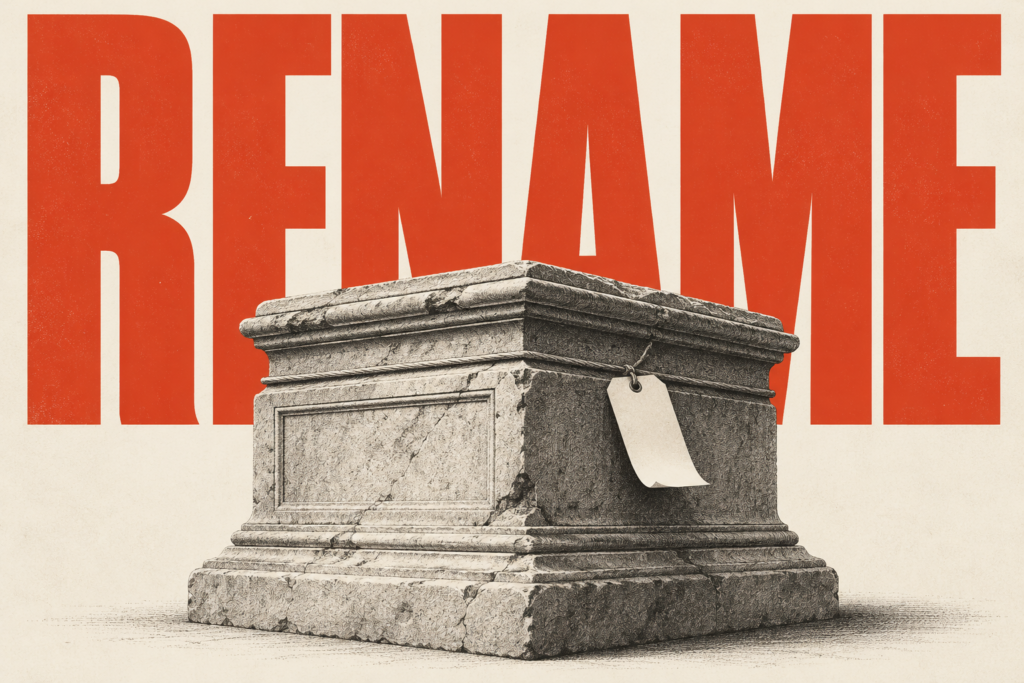
You Can Change the Name Without Changing the Question
This brings us to an interesting feature of the disagreement.
Suppose the Christian says that all contingent reality ultimately depends upon an eternal, necessary, uncreated source.
The atheist objects to the word God.
Very well. Remove the word.
Call it the ultimate ground.
Call it necessary reality.
Call it the source of being.
Call it the fundamental explanation of existence.
What has changed?
If we are still referring to precisely the same reality, nothing has changed except the sound we make to identify it.
The label is not the substance.
But there is an important qualification.
Not every proposed ultimate foundation is automatically the Christian God.
An impersonal necessary reality is not, merely by being necessary, the Holy Trinity. A mathematical structure is not, merely by being eternal, the divine Logos.
The Christian argument must establish more than the existence of some ultimate foundation.
It must explain why that foundation is personal, rational, uncreated, and ultimately identifiable with the God revealed in Christ.
That is where Orthodox theology becomes indispensable.
The argument is not that every atheist secretly believes in the Trinity under another name.
It is that changing terminology cannot remove the underlying metaphysical questions, and that Christianity offers a specific account of their ultimate answer.
If you rename what is real, you have not changed what is real. You have changed how you refer to it.
The question is whether your new description adequately captures the reality it attempts to explain.
Rules, Regularities, and the Author of Creation
We can approach the same issue through the concept of order.
The universe exhibits regularities.
Human beings discover these regularities and formulate laws to describe them.
But we should distinguish between different meanings of the word law.
A civil law is prescribed by an authority.
A law of logic expresses a principle of valid reasoning.
A physical law describes a relationship or regularity in nature.
These are not identical kinds of law, and we cannot prove the existence of a divine lawgiver simply by treating them as though they were.
Nevertheless, the Christian understanding of creation offers a reason why the physical universe possesses an ordered nature.
It is not an independent system that happened to become intelligible.
It is the work of an intelligent Creator.
This also provides a theological framework for understanding miracles.
A miracle is not a moment when truth becomes false.
It is an extraordinary act of God within the created order.
For example, the resurrection of a dead person does not make it false that human beings ordinarily die, or that death is normally irreversible through natural processes.
Rather, the Christian claim is that God, who is the source of life, can act beyond the ordinary capacities of created nature.
The exception does not eliminate the regularity against which it is recognized.
It makes the extraordinary event recognizable as extraordinary.
But an exception alone does not prove divine intervention. Unusual outcomes may arise from incomplete knowledge, rare natural conditions, or mistaken expectations.
To establish a miracle, we must examine not only whether an event occurred, but also whether there is adequate reason to attribute it to divine action.
This is entirely consistent with the Christian commitment to objective truth.
A miracle is not true because someone calls it a miracle.
It is true if the event actually occurred, and its divine explanation is warranted.
Christianity does not require us to abandon reason to recognize miracles.
It claims that the Author of the natural order is not imprisoned within the ordinary operation of that order.
The Problem of Borrowed Intelligibility
Presuppositional debates frequently involve an accusation of intellectual borrowing.
The Christian argues that the atheist uses logic, objective truth, and scientific reasoning while rejecting the ultimate foundation that makes them possible.
The atheist may reverse the accusation, claiming that Christianity borrows naturalistic explanations and adds unnecessary supernatural assumptions.
But neither accusation is established simply by making it.
Logic does not belong to atheists because atheists use it.
Nor does its use automatically demonstrate the truth of Christianity.
The real question is which worldview can adequately account for the things both parties use.
This is where the transcendental argument must do its work.
A naturalist may accept objective truth and logical necessity without accepting God. That is not automatically a contradiction.
The Christian must show why the naturalist’s proposed foundations are ultimately insufficient.
Likewise, the naturalist must do more than declare the Christian foundation incoherent.
He must identify the alleged contradiction.
It is not enough to say that God is an unnecessary addition to an otherwise intelligible reality.
That assumes the very thing being disputed: that reality is ultimately intelligible without God.
The debate is not about which side uses reason.
Both sides do.
The debate is about what makes reason possible, and which account of reality best explains its existence and applicability.
The Difference Between Assuming Truth and Accounting for It
There is a final distinction worth preserving.
A person can know something without possessing a complete philosophical explanation of why knowledge is possible.
A child can know that fire is hot without understanding thermodynamics.
A scientist can accurately describe a physical phenomenon without resolving every metaphysical question about existence.
And an atheist can reason correctly without believing in God.
The Orthodox transcendental argument does not need to deny any of these things.
Its claim is deeper.
It argues that the atheist’s ability to reason is possible because reality is grounded in God, whether the atheist recognizes that ground or not.
This is why the argument is about ontological dependence rather than merely conscious belief.
The Christian is not saying that a person must first believe in God before performing a valid calculation.
He is saying that the possibility of valid calculation, and the rational order it describes, ultimately depend upon God.
That is a far more substantial claim.
And it is the claim that must be defended.
What Makes Your Worldview True?
We can now return to the original challenge.
“Your worldview is false. Let me convert you to atheism.”
My response is straightforward.
What exactly is your position?
Is it objectively true?
Would it remain true even if nobody believed it?
What makes it true?
How does your worldview account for the logic and intelligibility you are using to defend it?
And what is your argument that these things are possible without God?
These questions are not attempts to escape criticism.
They are invitations to examine the foundations of the criticism itself.
If someone claims that Christianity is false, I am entitled to ask what makes that judgment true.
And if someone claims that God is unnecessary for intelligibility, I am entitled to ask for an account of intelligibility that does not presuppose what the argument is supposed to establish.
The Christian must accept the same standard.
It is not enough to declare that God is the foundation of truth.
We must show why this account is coherent, why it is necessary, and why the God of Christian revelation is the proper conclusion.
That is the philosophical task of TAG.
And Orthodoxy does not approach this task with an anonymous first cause or an abstract philosophical placeholder.
It begins with the living God: Father, Son, and Holy Spirit.
With the eternal Logos through whom all things were made.
With creation as the expression of divine wisdom.
With humanity made in the image of God, capable of knowing reality because reality is not alien to reason.
With the distinction between God’s unknowable essence and His genuinely knowable energies.
With a universe that is neither self-existent nor meaningless, but contingent upon the One who is.
The Reality Behind the Name
Ultimately, the argument is not about protecting a word.
It is about identifying what is real.
We do not create reality by naming it.
We discover it, describe it, and attempt to understand it.
We can call the regularities of nature laws. We can call their mathematical expressions equations. We can call the rational structure of the world intelligibility.
None of these names explains itself.
The Christian claim is that the deepest explanation is not another contingent object within the universe.
It is the uncreated source of the universe itself.
And Orthodoxy identifies that source not as an impersonal abstraction, but as the Triune God, whose eternal Logos is revealed in Jesus Christ.
One can dispute that identification.
One can propose another metaphysical foundation.
One can argue that no further foundation is necessary.
But simply changing the terminology does not settle the question.
Calling the foundation of reality something other than God does not, by itself, demonstrate that God is absent. Nor does calling that foundation God, by itself, establish the Christian doctrine of God.
We must examine what the proposed foundation actually is.
Because the question has never been what we choose to call reality.
The question is what reality actually is.
And if Christianity is true, then the Logos is not merely the name Christians have given to reason.
He is the reason there is an intelligible world to name in the first place.
You can change the word.
You cannot change what is the case.
And if the Logos is the ultimate ground of what is the case, then you can rename God as many times as you please.
You have not removed Him.


